Rotary Club of
New York
International
Service Division
Sylvan Barnet, Chairman
“Sustainable
Development, Poverty and the World’s 50 Poorest Nations”
By Anne Kerr
Chief - Major Group & Partnership Branch
Division for Sustainable Development (DESA)
United Nations, New York
The following remarks are
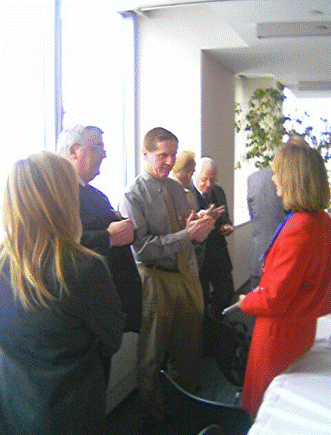
part of the discussion that took place at the monthly breakfast meeting of the
International Service Division of the Rotary Club of New York. The meeting was held on March 17, 2004 at the
German Permanent Mission to the United Nations in New York City. Present at the
meeting were Sylvan Barnet, Giorgio Balestrieri, Sekou Conde, Bill Delong, Eric
Enroth, Bernhard Fabricius, John German, Hugh G. Hamilton, Josef Klee, Tom
McConnon, Klaus-Heinrich Standke, David Stillman, Mikio Tajima, Vetor Unit, and
our speaker Anne Kerr. This is a
condensed and edited transcript that is made available as a resource for
Rotarians to remain well-informed on current issues facing the International
Development community. The meeting was opened and moderated by Mr. Barnet.
Sylvan Barnet: Clean water is the world’s
most precious resource. However, UNICEF reports that 30% of childhood diseases
in developing regions are attributable to contaminated water. Therefore, for our 100th
anniversary, Rotarians have formulated a major program that is geared toward
developing clean water resources around the world.
Our
emphasis is concentrated on the following:
Ÿ
Promote conservation of water resources.
Ÿ
Assist communities in cleaning up lakes, rivers, streams and other
water resources.
Ÿ
Provide water wells, and other sources of water, to low-income
communities.
Ÿ
Demonstrate effective partnerships with local organizations, Ministries
of Health and other organizations that
provide water resource management.
Ÿ
Provide assistance to farmers regarding water use.
We
will also address the U.N. program known as “W.A.S.H.”, which is an acronym for
the Water, And Sanitation, and Hygiene program.
On
November 6, 2004 we will have United Nation’s Day for Rotary. Our
organization’s president will be there as well as past-presidents and our board
of directors. The main subjects for discussion will be water and sanitation. The other areas of discussion at the U.N. Day
will be Polio and HIV /AIDs. We will
continue our work on guinea worm, measles, and especially dysentery, which is
caused by dirty water and sanitation. We
now have a letter exchange with UNESCO that was signed in December, 2003 to
promote joint projects.
Regarding
Polio Plus, we hope to be finished by the end of this year. We are now down to
about 300 cases world-wide. These cases are in West Africa, Nigeria and
India. It should be pointed out that
India is an incredible story: Despite
two years ago there was a sudden outbreak of about 1000 cases in India. Right now the count is down to less than 100
cases. Now we will demonstrate the same
efforts to provide safe drinking water.
So that is where we are.
And
now it is my pleasure to introduce Anne Kerr.
A Canadian national, Anne is the Chief of Program Coordination, Major
Groups and Partnerships Branch, Division for Sustainable Development at the
United Nations Department of Economic and Social Affairs (DESA). She earned a
Bachelors degree in Geography from the University of British Columbia,
Vancouver and a Master’s degree in Regional Planning and Resource Development
from the University of Waterloo, in Ontario.
Anne
joined the United Nations in November 2001 as Chief, National Information,
Strategies and Institutions Branch, Division of Sustainable Development (CSD)
Secretariat, and was involved in tracking the substantive sessions of the
preparatory meeting for the World Summit on Sustainable Development (WSSD) as
well as the World Summit on Sustainable Development itself, held in
Johannesburg, South Africa in 2002.
For
over 25 years, Anne worked with the Canadian government and managed Canada’s
National Environmental Indicators Program from 1990 to 2001, and represented
Canada internationally in the field.
Please welcome Anne Kerr.
Anne Kerr: First of all, I would like to thank the Rotary Club
of New York for inviting me to this morning’s meeting. I am indeed honored to be here during your
organization’s 100th year. I
also bring greetings from Ms. Joanne DiSano, Director of the Division for
Sustainable Development.
I
was asked to lead a discussion related to sustainable development and poverty
eradication in least developed countries.
I am going to focus my remarks on review of progress toward 3 key
targets related to poverty eradication that are the themes for the 12th
session of the Commission on Sustainable Development (CSD) taking place on
April this year, while also making references to the least developed countries
(LDCs).
First
let me start with a quote from the Johannesburg Declaration on Sustainable
Development about the challenges we face:
Ÿ
“We recognize that poverty eradication, changing consumption and
production patterns, and protecting and managing the natural resource base for
economic and social development are over-arching objectives of, and essential
requirements for, sustained development.”
Eradicating
poverty has been called the greatest global challenge facing the world today,
and for the 600 million people living in the 50 least developed countries, the
special support and initiatives for poverty eradication called for in the
Brussels Program of Action for LDCs cannot come too soon.
The
main focus of the United Nations Commission on Sustainable Development (CSD) is
the implementation of the Johannesburg Plan of Implementation (JPOI)
- A plan that covers all aspects of the
Brussels Program of Action.
At
its 11th session in 2003, CSD set out a program of work to the year
2017 to make progress towards the implementation of targets, commitments and
goals made in Agenda 21, and the Johannesburg Plan of Implementation (JPOI) -
the latter agreed to the World Summit on Sustainable development (WSSD) in
Johannesburg in 2002. The work program
comprises 2-year action-oriented implementation cycles - a review year and a
policy year. The review year is to evaluate the progress, obstacles, constrains
successes and lessons learned. The
policy year is to determine further actions required to accelerate and enhance
implementation and overcome obstacles.
The
upcoming 12th session of the Commission on Sustainable Development
will review sustainable development commitments in the area of water,
sanitation and human settlements.
Drawing
from the Secretary-General’s reports prepared for CSD-12 just released, which
review progress in meeting goals, targets, and commitments of Agenda 21,
program for Further Implementation of Agenda 21 and the Johannesburg Plan of
Implementation, I am going to focus on three targets which relate particularly
to LDCs:
First,
to halve, by the year 2015, the proportion of people who are unable to reach or
to afford safe drinking water; second, to halve, by the year 2015, the
proportion of people who do not have access to basic sanitation. The third is to achieve by the year 2020 a
significant improvement in the lives of at least 100 million slum dwellers.
Let
me start with the last one, first. Slums are characterized by substandard
housing, overcrowding, insecure tenure and lack of basic services such as safe
water, improved sanitation, transportation, and electricity. They exist in run-down inner city
neighborhoods, urban-fringe squatter areas or shanty towns.
According
to U.N. Habitat, slum populations make up 6% of urban populations in developed
countries, 43% of the population in the developing countries and a whopping 78%
of the population in least developing countries. If the current trend continues, the number of
slum dwellers world wide is projected to rise from the current 924 million to
about 2 billion over the next 30 years.
Basic services and infrastructure must be provided if the crushing
impact of poverty, social exclusion and unhealthy living conditions in slums
are to be mitigated. It should be pointed out that developed countries spend on
average, 32 times more per person on infrastructure and urban services than
cities in LDCs.
The
second target is access to safe drinking water. I know that this is an area
of great concern to Rotarians.
Contaminated drinking water is a major source of illness and death in
developing countries. During the 1990s,
the number of people with access to improved drinking water supply increased
from 70% of the global population to 82% in 2000. This represents significant progress but is
well below the rate required to meet the 2015 target. The greatest gains were in South Asia which
is on track to meet the target. However, sub-Saharan Africa and Oceania have
the lowest access rates - 58% and 48% respectively. The challenge in sub-Saharan Africa is more
complex due to large displaced and refugee populations, countries in conflict
or reconstruction, and HIV / AIDs pandemics.
There
are wide disparities in access for safe drinking water between urban and rural
populations. In the least developed
countries, 38% of the population is without access to improved drinking water. This is segmented in 18% urban areas and 45%
in rural areas. Based on current urban
and rural access rates and using projected population figures, an additional
358 million people in LDCs will need access to improved drinking water to meet
the 2015 target.
So
what needs to be done? In terms of slums, pro-active shelter provision policies
and programs that seek to avert further slum growth and encourage
expansion of low-cost housing stock and associated infrastructure need to be
implemented locally. Slum upgrading and integration, rather that eradication of
slums and relocation of slum dwellers will be more effective since it must be
noted that past eradication of slums has destroyed large stocks of affordable
housing and simply displaced slum dwellers from one informal settlement to
another.
Access to credit markets and job creations
programs will also be helpful.
Regarding
safe drinking water: contaminated water sources, inadequate maintenance of
pumps and distribution systems and leakage of water from pipes are the main
problems that need to be overcome. Due
to the increasing financial and environmental costs of developing new sources
of water, it is generally more cost effective to increase the effective water
supply by reducing leakage and water losses.
Improved sanitation is essential to increasing the availability of safe
drinking water and improving living conditions in human settlements. However, very few countries have incorporated
sanitation programs explicitly in their national development and poverty
reduction strategies.
The
recent Secretary-General’s report for CSD-12 reviewed progress in providing
access to improved sanitation in dispersed rural settlements, medium-density
communities and high-density urban communities. Among other things,
education and awareness-raising programs have to build demand for sanitation
technologies appropriate to the conditions.
Many NGOs and community organizations have mobilized substantial
resources for sanitation for both facilities and awareness-raising. Rotary
International is an example of an organization with tremendous ability to
mobilize resources in this area.
I
would like to conclude with another quote from the Johannesburg Declaration on
Sustainable Development regarding our commitment to sustainable development:
Ÿ
“We recognize the reality that a
global society has the means, and is endowed with, the resources to address the
challenges of poverty eradication and sustainable development confronting all
humanity. Together, we will take extra
steps to ensure that these available resources are used to the benefit of
humanity.”
We
salute Rotary International’s 100 years of efforts on taking those extra steps
to confront the challenge. And I would
recommend for Rotarians to log on to our website at www.un.org/esa/sustdev/ and
click on to the “Partnership” section.
There you will find a data base of more that 260 “Partnership
Initiatives” that your respective clubs may find useful. In addition, the upcoming “Partnership Fair”
at CSD-12 will offer a number of booths and videos that will help identify
potential projects.
This transcript was produced and edited by Tom McConnon. We welcome
your questions and comments.
Rotary Club of
New York
322 Eighth Ave. New York, New York 10001
Tele: (212)
633-1311 Fax (212)
633-1954 E-Mail:
ny.rotary@verizon.net
www.newyorkcityrotary.org